
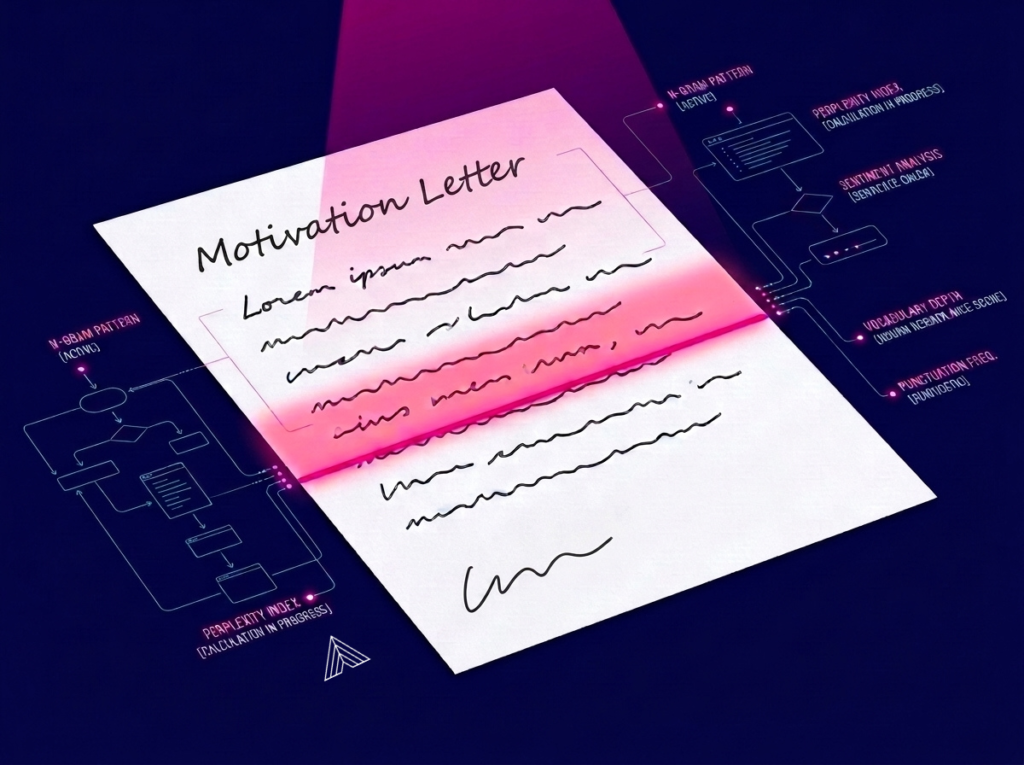
Before a human reads your motivation letter, software might read it first. A meaningful share of admissions offices now run submitted essays through AI-detection tools such as Turnitin or GPTZero as an early screening step, flagging text that looks machine-generated before anyone opens the applicant’s file for a full review.
That doesn’t mean every school does this, or does it the same way. Policies vary widely, and several institutions have quietly turned detection tools off after they misfired on real students. But the direction is clear enough that assuming only a person will read your motivation letter is no longer a safe bet.
This piece breaks down what these tools are actually trained to catch, why writing that sounds too smooth can now work against you, who gets wrongly flagged, and what still makes a letter unmistakably yours.
What this article covers:
🤖 Why admissions offices started screening essays with AI in the first place
🔍 What an AI detector is actually trained to notice
⚠️ Why an overly polished letter can now raise more questions than it answers
🎯 Who gets falsely flagged, and why that risk isn’t spread evenly
✅ What actually gets a motivation letter through, screened or not
Why Are Admissions Offices Screening Essays With AI Now?
Generative AI use among students has become the norm rather than the exception — recent survey data puts the share of U.S. teens who’ve used an AI chatbot for schoolwork above half. Admissions offices have responded by adding a layer of scrutiny that simply didn’t exist a few years ago. The Common Application’s fraud policy already treats substantive AI-generated content in an essay as application fraud, and many applicants are now asked to sign an attestation confirming the work is entirely their own.
What this means for your application:
Assume screening is possible, not guaranteed, and write for a process that may include both a machine and a person – not just one or the other.
What Is an AI Detector Actually Looking For?
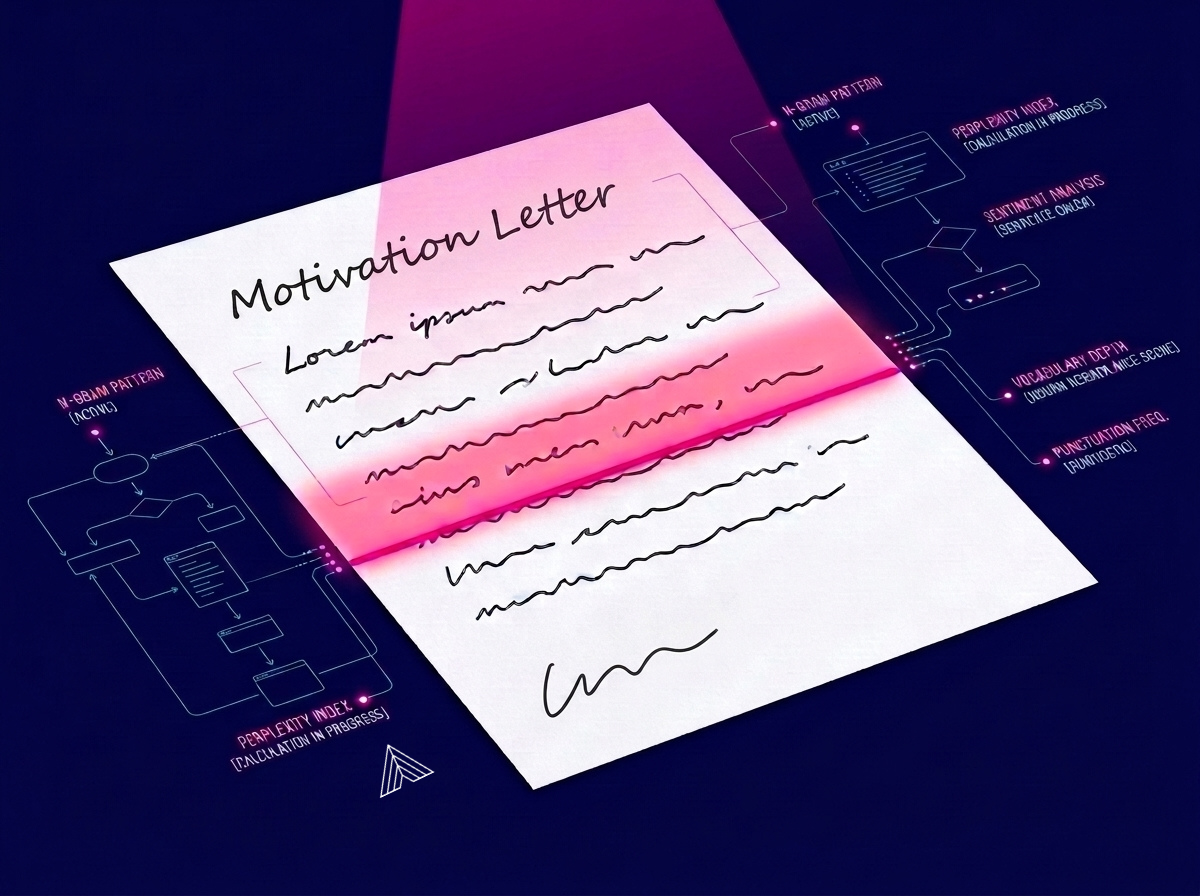
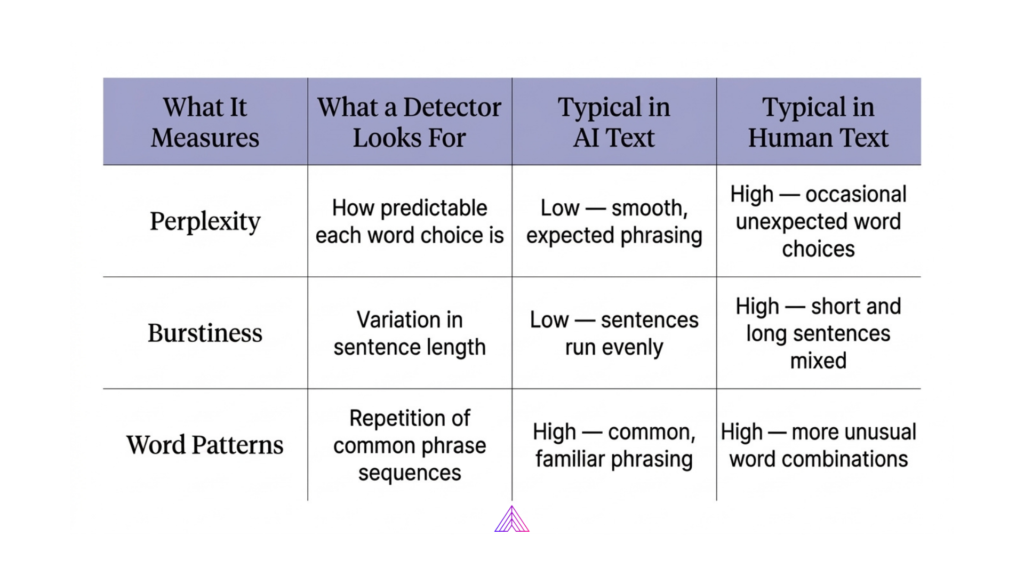
A detector isn’t reading your letter for meaning. It’s scanning for statistical patterns that language models tend to produce: unusually smooth sentence rhythm, predictable word choice, and low variation between one sentence and the next. Human writing tends to be uneven in a specific, measurable way; researchers call that unevenness burstiness, and its absence is one of the clearest tells a detector looks for.
A Cornell study published in January 2026 tested AI-detection tools on real and AI-generated admissions essays and found they were highly accurate overall. But ‘highly accurate overall’ isn’t the same as ‘always right about your essay.’ A detector can get the big picture right across thousands of essays and still misjudge any individual one – including yours.
What this means for your application:
A detector isn’t reading your personality. It’s reading your rhythm.
Why Can “Sounding Polished” Now Work Against You?
Here’s the part most people don’t expect: even if you write every word yourself, running your draft through an AI tool to ‘tighten it up’ or ‘make it flow better’ can backfire. That kind of editing smooths out the natural unevenness of real writing – the exact thing detectors are trained to notice is missing. Your ideas stay yours, but the rhythm starts to look machine-made. A rougher first draft, with sentences that vary in length because you actually paused and thought between them, often reads as more human precisely because it isn’t perfectly even.
Nobody thinks in perfectly smooth sentences.
What this means for your application:
Resist the urge to smooth out every rough edge. Some of them are the proof it’s yours.
Who Gets Falsely Flagged?
Wrongly-flagged essays are the least talked-about part of this system and they don’t happen to everyone at the same rate. Formulaic sentence structure and simpler vocabulary — common among non-native English speakers writing in their second or third language — can trigger the same statistical flags as AI-generated text. It’s a fairness problem serious enough that several universities, including Johns Hopkins, Vanderbilt, UC San Diego, and UCLA, have disabled AI-detection tools entirely after concluding the tools weren’t reliable enough to act on alone.
In practice, most schools that do use detection treat a flag as a prompt for closer human reading, not an automatic rejection. The software raises a hand; a person still makes the call.
What this means for your application:
If English isn’t your first language, simple sentence structure doesn’t mean fake. Write the way you actually think, not the way a template suggests you should sound.
So, Is Using AI Off the Table Entirely?
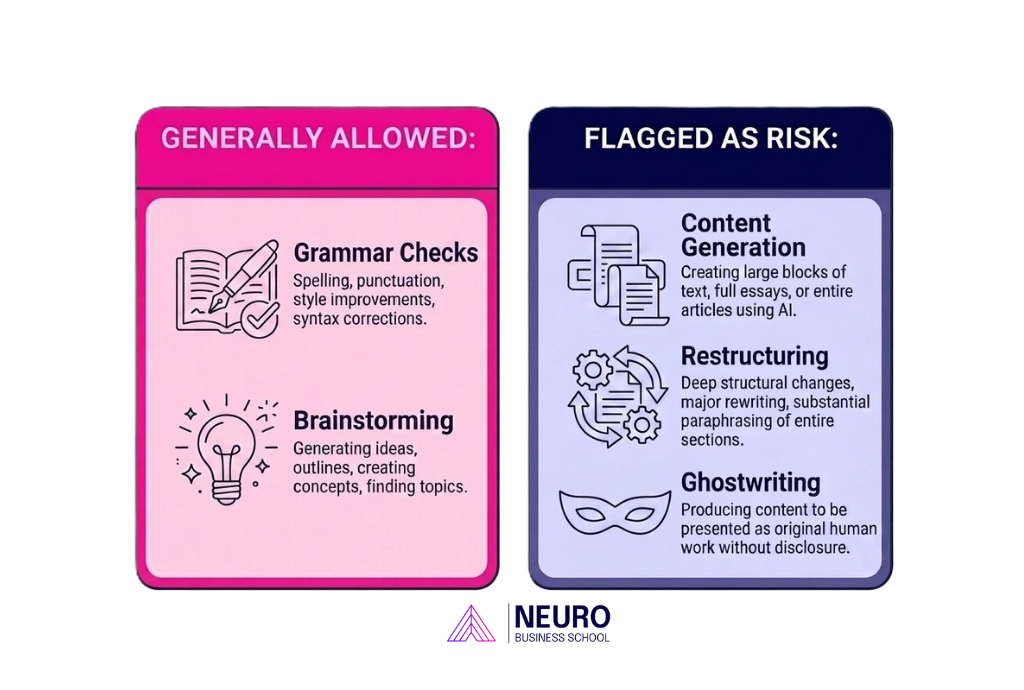
Not entirely, but the line matters. Several schools explicitly permit AI for grammar and spelling checks, and treat that use as no different from a human proofreader. What crosses into risk is asking a tool to generate new sentences, restructure your story, or write a paragraph you didn’t draft yourself – that’s the exact pattern detectors are built to catch, and several honor codes classify it as a form of academic dishonesty regardless of whether software ever flags it.
The safest use of AI in a motivation letter is as a proofreader, never as a ghostwriter.
What Actually Gets a Motivation Letter Through

Photo by Zen Chung on Pexels
✍️Draft from memory
Write the first full draft with no tool open – from memory, in your own words, badly if it has to be badly at first.
📌 Anchor a real detail
Anchor at least one paragraph in a specific, verifiable detail: a number, a name, a moment only you experienced. That’s the hardest thing for any tool to invent convincingly on your behalf.
🗣️ Read aloud
Read it out loud before submitting. If it doesn’t sound like something you’d actually say, revise it back toward how you talk.
✅ AI only for proofreading
If you use AI at all, use it only after the draft already exists, and only for grammar and spelling – never for new sentences or restructuring.
〰️ Vary sentence rhythm
Let some sentences run long and some run short. Real writing is uneven. Perfectly balanced paragraphs are a tell, not a strength.
At Neuro Business School, we’re not looking for a perfectly polished letter. We’re looking for real thinking. What we’re looking for isn’t polished language. What stands out is whether your reasoning holds up, and whether your reasons for choosing NeuroMarketing or NeuroBusiness are genuinely your own. The admission process is fully online, for applicants writing from anywhere in the world.
Sources
1. Common Application (2026). Policy on academic integrity and AI-generated content in application essays.
2. Cornell University (January 2026). Research on AI-text classifiers applied to real and synthetic Common App admissions essays.
3. Pew Research Center (2026). Survey data on U.S. teen use of AI chatbots for schoolwork.
4. Reporting on university AI-detection tool adoption and discontinuation — Johns Hopkins, Vanderbilt, UC San Diego, and UCLA admissions offices, 2025–2026.
5. Reporting on admissions policies explicitly permitting AI-assisted grammar review, including Yale and Caltech, 2025–2026.