
Somewhere in the last decade, the most interesting business thinking stopped coming from strategy consultants and started coming from neuroscientists.
That shift has a name: NeuroBusiness. And if you work in marketing, leadership, strategy, orAI — or if you’re wondering whether the MBA format has become a 20th-century solution to a 21st century problem — it’s worth understanding what this field actually is, and why it’s growing fast.
NeuroBusiness is the applied study of how neuroscience explains and improves business decisions. Not in an abstract way. In a “this is why your customer abandoned the checkout page” and “this is why your leadership team keeps making the same strategic mistake” way.
The Gap That NeuroBusiness Fills
Standard business education has an uncomfortable assumption buried inside it: that humans make decisions rationally. We gather information, weigh options, calculate risk and reward, and choose the best outcome available to us.
Decades of neuroscience say otherwise.
The brain makes most decisions before conscious reasoning kicks in. Antonio Damasio’s landmark research on patients with damage to the prefrontal cortex — the part of the brain associated with rational decision-making — showed something counterintuitive: removing the emotional component didn’t make people better decision-makers. It made them unable to decide at all. Emotional processing is not the opposite of rational thinking — it is part of it.
This has direct implications for every business discipline. It means consumer choices are not primarily logical. Leadership decisions are not made in a vacuum of pure analysis. Negotiations
are shaped by what the amygdala does before the prefrontal cortex has a chance to respond. Traditional business education doesn’t teach any of this. NeuroBusiness does.
What the Field Actually Covers
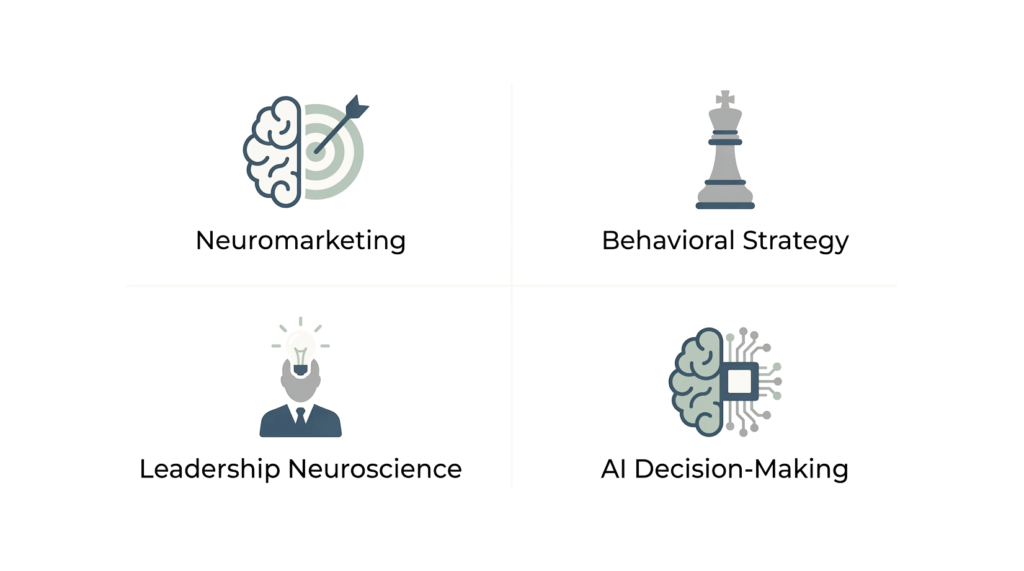
NeuroBusiness sits at the intersection of four disciplines: neuroscience, psychology, economics, and business strategy. In practice, it includes neuromarketing, behavioral strategy, leadership neuroscience, and AI-augmented decision-making — but these aren’t separate silos. They’re different lenses on the same core insight: that understanding the brain changes how you operate.
Here’s what that looks like in each area:
Neuromarketing uses brain science to understand how people respond to products, brands, pricing, and communications. One well-known example: pricing a product at €99 instead of €100 isn’t a gimmick — it’s a consequence of how the left digit anchors value perception in the brain. Studies published in the Journal of Consumer Research have consistently shown that charm pricing influences purchasing behavior even when buyers are aware of the tactic. Most brands use this principle. Very few can explain the neuroscience behind it.
Behavioral strategy applies findings from behavioral economics to how organizations make decisions. The classic demonstration here is the Ultimatum Game from experimental economics: when offered a split of money that feels unfair (say, €20 of a €100 split), people routinely reject the offer — even though any money is better than nothing by pure rational calculation. The brain treats perceived fairness as a concrete cost. Leaders who understand this design negotiations, compensation structures, and change management processes differently.
Leadership neuroscience examines what stress, sleep deprivation, social dynamics, and cognitive load do to executive judgment. The research is uncomfortable. Under high pressure, the brain’s threat-detection systems can override the slower, deliberative reasoning required for good strategic decisions. Almost nobody in senior leadership gets training in how their brain changes under the exact conditions they face most often.
AI-augmented decision-making is the newest branch, and arguably the fastest-growing. As AI systems take over more routine analysis, the remaining decisions are almost entirely judgment calls. Understanding human decision-making biases isn’t optional when you’re overseeing AI recommendations — it’s the whole job.
Why This Matters More Now Than It Did Ten Years Ago
Three things are converging.
First, the research has caught up. The neuroscience of decision-making is no longer speculative. Functional MRI studies, behavioral experiments at scale, and decades of clinical observation have produced findings robust enough to act on. The gap between academic neuroscience and applied business practice is closing.
Second, the business problems are changing. For most of the 20th century, competitive advantage came from access to information and capital. Those advantages have been commoditized. The brain doesn’t optimize — it satisfices (Herbert Simon’s term: it seeks “good enough” rather than perfect). Understanding this is now the edge, because most competitors are still designing strategies as if humans were rational actors.
Third, AI is forcing the question. The skills that AI doesn’t replicate well are precisely the ones neuroscience helps develop: reading social dynamics, managing uncertainty, making high stakes calls with incomplete information, building trust under pressure. The future of business leadership is more human, not less — but in a specifically neuroscientific sense of what human means.
What You Can Do With a NeuroBusiness Degree

This isn’t an academic discipline you study and then leave in the classroom. Graduates apply it across industries and functions.
Marketing professionals use neuromarketing principles to redesign customer journeys, understanding that the moment of hesitation on a product page isn’t a logical calculation — it’s a threat response in the insular cortex that a better design can prevent.
Senior leaders apply leadership neuroscience to understand their own cognitive biases and those of their teams — running better meetings, making cleaner decisions under pressure, and designing organizational cultures that reduce cortisol-driven short-termism.
Strategy consultants use behavioral economics frameworks to anticipate how clients will actually respond to change, rather than how they theoretically should.
And increasingly, executives working with AI systems use NeuroBusiness principles to understand where algorithmic recommendations stop and human judgment must begin.
None of this requires you to become a neuroscientist. It requires you to understand enough brain science to operate differently — which is exactly what a structured programme is designed to provide, without stepping away from the career you’ve already built.
The Future of Business Education
The MBA was designed for a world that no longer exists at quite the same scale: large, stable organizations competing on rational strategy in relatively predictable markets. That world hasn’t disappeared — but it has changed enough that a degree built entirely on its assumptions is leaving something important on the table.
The gap NeuroBusiness fills isn’t just intellectual. It’s practical. Every business decision involves a human brain, and every human brain has predictable patterns that most decision-makers are never taught to recognize.
That’s starting to look like a significant competitive disadvantage for those who don’t address it.
If you want to understand more about how the Master in NeuroBusiness program is structured and who it’s designed for, it’s available fully online.
Sources
Damasio, A. R. (1994). Descartes’ Error: Emotion, Reason, and the Human Brain. Putnam. [The foundational study on the role of emotion in rational decision-making; clinical observation of patients with prefrontal damage, not a controlled RCT.]
Güth, W., Schmittberger, R., & Schwarze, B. (1982). An experimental analysis of ultimatum bargaining. Journal of Economic Behavior & Organization, 3(4), 367–388. [Original Ultimatum Game study; widely replicated.]
Thomas, M., Simon, D. H., & Kadiyali, V. (2010). The price precision effect: evidence from laboratory and market data. Marketing Science, 29(1), 175–190. [On left-digit anchoring and pricing perception.]
Simon, H. A. (1956). Rational choice and the structure of the environment. Psychological Review, 63(2), 129–138. [Origin of the “satisficing” concept.]
Ariely, D. (2008). Predictably Irrational. HarperCollins. [Behavioral economics in accessible form; a widely cited popular treatment, not a primary study.]